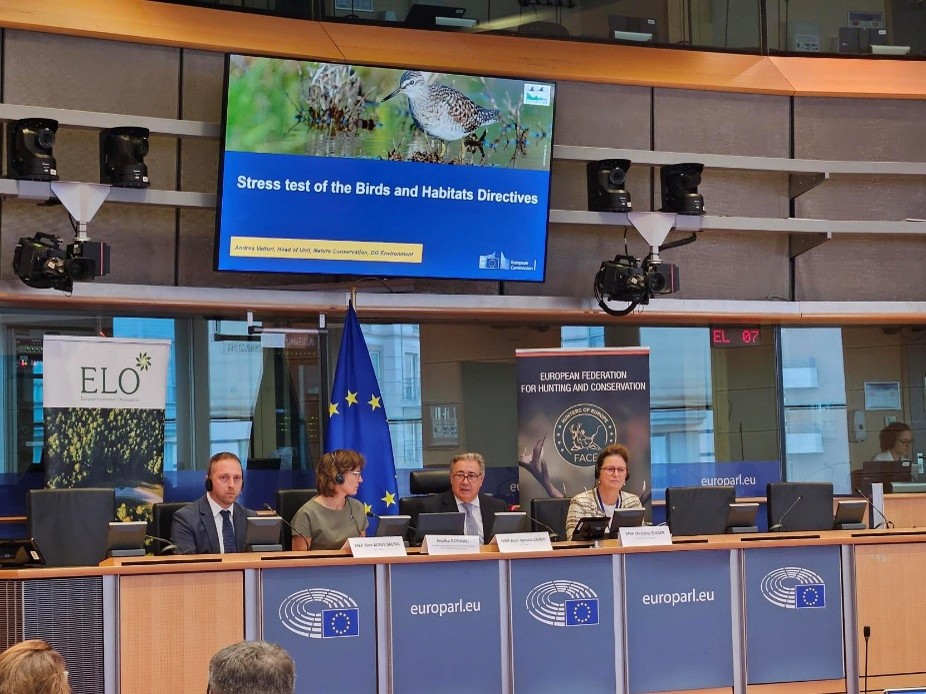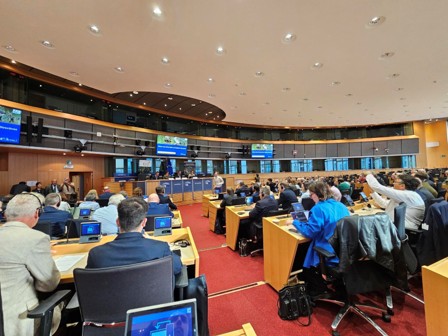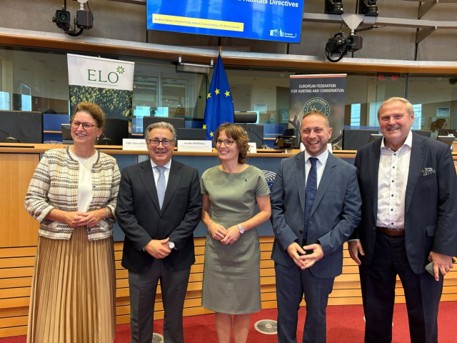
On 29 September, ProtectFish partner Aliénor attended the event “The Stress Test of the Nature Directives: Next Steps for Wildlife Conservation and Management in Europe” at the European Parliament in Brussels.
This event was organised by the European Parliament’s ‘Biodiversity Hunting Countryside’ Intergroup, together with the European Federation for Hunting and Conservation (FACE) and the European Landowners’ Organization (ELO), to discuss the practical implementation of the EU’s Birds and Habitats Directives and the European Commission’s ongoing stress test of these rules.
EU Nature Directives’ stress test: conservation & management in practice
Announced in December 2025, the stress test builds on the Commission’s 2016 Fitness Check. The stress test will assess whether the Directives remain fit to achieve their objectives cost-efficiently, including by identifying opportunities to reduce administrative burdens in implementation.
Drawing on stakeholder input and Commissioner Roswall’s implementation dialogues, the stress test covers three main areas:
- The application of Article 6 of the Habitats Directive, with a focus on the appropriate assessment procedure for Natura 2000 sites;
- Policy coherence, stakeholder participation, funding support and governance, including monitoring and reporting;
- Species protection and derogations, and procedures for adapting the annexes to scientific and technical progress.
The European Commission’s 2026 stress test of the Birds and Habitats Directives was therefore a central focus of the event.
Participants discussed how these rules work across Europe, with a central question: how can conservation policies be grounded in evidence while remaining workable for those managing wildlife on the ground?
Conservation outcomes and practical implementation – insights from EU Commissioner Roswall
European Commissioner for Environment, Water Resilience and a Competitive Circular Economy Jessika Roswall set out the central question behind the event’s topic:
“Can we achieve the objectives in the Nature Directives more efficiently and with less administrative burden — while maintaining their ambition and level of nature protection?”
She emphasised that simplification should maintain environmental standards and ambition, while making the rules clearer and easier to implement. She also highlighted the effective use of available data and the flexibility needed to account for local differences.
“A protection regime is only successful if populations are actually recovering or maintained in a healthy state,” she stated.
Roswall also explained that the Commission is exploring how species protection status could be adapted more easily to changes in conservation status.
You can read her full speech via this link
Speakers highlight challenges in species management, implementation & evidence
The panel discussion further addressed the practical challenges of species protection throughout Europe – and within the framework of the EU Nature Directives.
MEP Christine Singer (Germany, Renew Europe) raised the issue of fish losses caused by cormorants and otters in pond farming and called for procedures to mitigate this based on scientific evidence.
MEP Alex Agius Saliba (Malta, S&D) focused on the flexibility already available under the Directives, including derogations, and the difficulties encountered in implementing it.
Mr. Andrea Vettori, Head of the European Commission’s Nature Conservation Unit, highlighted data gaps identified through consultation with stakeholders, alongside the need to strengthen implementation capacity and stakeholder participation. He stressed that the ongoing stress test has no predetermined outcome and will draw on input from stakeholders and Member States.
Why this matters for ProtectFish?
Many species of river fish are in a very poor conservation status and even those that are protected by the Habitats Directive are not regularly monitored. Documentation of the population trend and status information is often lacking.
ProtectFish investigates predation and its implications for threatened river fish. One of its central research questions is whether reducing predation impact from cormorants can significantly improve the conservation status of riverine fish species listed under the Habitats Directive (as e.g. grayling – Thymallus thymallus).
ProtectFish findings will support conservation status assessments, where limited national monitoring and reporting leave considerable data gaps. The project will also provide methodologies and recommendations to identify population recovery and habitat restoration needs under the EU Birds and Habitats Directives.
This event’s focus on monitoring, species management and practical implementation of the EU Nature Directives was therefore directly relevant to ProtectFish’s work.