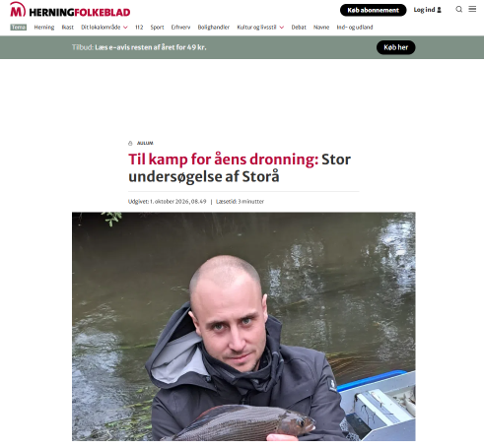
On 1 October 2026, Danish newspaper Herning Folkeblad published an interview with Mathis Olesen, biologist at DTU Aqua. During an electrofishing survey on Denmark’s Storå River, Olesen spoke about the work underway on the Storå River to monitor fish populations and investigate ways to protect threatened grayling, with support from local volunteers. He found that fish biomass in this river appears to be increasing, but remains far below historical levels.
Explaining the research to a wider audience
The interview focused on “Projekt Stalling” (“Project Grayling”), a Danish study involving DTU Aqua which supports ProtectFish’ research in Denmark. This Danish study investigates the influence of cormorant predation on grayling populations and the potential benefits of deterrence measures since three years.
The research covers approximately 10 km of the Storå River, divided into three study sections: one where volunteers carry out cormorant deterrence activities, another monitored without deterrence, and a third serving as a control.
During electrofishing surveys fish are counted, weighed and measured before being released. These observations help researchers follow changes in fish populations across the study sections.
Encouraging observations, with recovery still a challenge
Speaking to Herning Folkeblad, Mathis Olesen indicated that fish biomass could exceed five kilograms per hectare of water surface in this year’s measurements of the river. The interview also included input from Søren Kiilerich, Chair of the local Ørre angling association, who coordinates (angling) volunteers supporting the Storå study site. He reported that fish biomass increased from 3.6 kilograms per hectare in the first year to 4.7 kilograms in the second year of the project’s course.
While these observations suggest an encouraging trend, Olesen stressed that fish biomass remains very low compared with estimated historical levels in the river. He also pointed to a possible effect of cormorant deterrence, without presenting this as a confirmed conclusion.
Local volunteers help bring research to life
More than 20 volunteers including anglers and landowners support the Storå fieldwork. Their involvement provides practical assistance to researchers and brings local knowledge of the river and changes in its fish populations.
The interview done by Herning Folkeblad brings ProtectFish’s research to local readers and gives further visibility to the shared efforts for a better understanding and protection of threatened freshwater fish.
DTU Aqua’s role in ProtectFish’ Danish fieldwork
DTU Aqua coordinates our Horizon Europe-funded ProtectFish project and carries out fieldwork in Danish rivers to assess measures for protecting vulnerable fish from cormorant predation.
Working with local volunteers, the team combines fish surveys, cormorant monitoring and deterrence activities to examine changes in fish populations. These findings contribute to ProtectFish’s wider European research and recommendations for freshwater fish conservation.
Further reading
Discover more about ProtectFish’s fieldwork in Denmark.
Source: Herning Folkeblad, “Til kamp for åens dronning: Stor undersøgelse af Storå”, 1 October 2026.