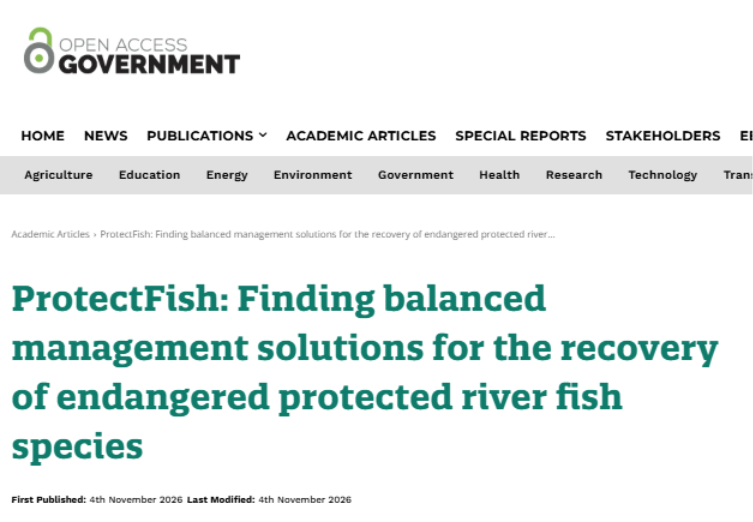
ProtectFish is featured in Open Access Government, a UK-based public policy magazine, with an article by the ProtectFish project coordinator, Dr Kim Birnie-Gauvin, Senior Researcher at DTU Aqua. Published on 4 November 2026, the article presents the project’s approach to supporting the recovery of threatened river fish and shares preliminary findings.
About Open Access Government
Open Access Government is a freely accessible digital publication covering public policy, research and innovation, the environment and other topics.
It features contributions from a range of authors, including researchers, policymakers and stakeholder organisations. While not a scientific journal, the publication offers ProtectFish an opportunity to share its research with a broader audience interested in environmental issues, biodiversity conservation and the role of science in informing public policy.
Research to support river fish recovery
In her contribution, Dr. Birnie-Gauvin explains how ProtectFish combines ecological research, field experiments, population modelling and stakeholder engagement to develop management and policy recommendations, with European grayling as its focal species.
As she writes:
“These preliminary findings show that freshwater fish decline cannot be tackled through isolated measures. Cormorant predation must be considered alongside other pressures.”
ProtectFish preliminary findings – shared with Open Access Government
In the article, the ProtectFish project Coordinator presents the following preliminary findings:
- Cormorant predation has direct and measurable impacts on fish populations, including mortality of adult fish and significant non-consumptive mortality caused by stress or injuries.
- Habitat complexity measures alone are insufficient to substantially reduce predation pressure – in EU rivers – under conditions of high predator density.
- Flow regime alteration, predation pressure and rising water temperatures are identified as among the strongest stressors (in that order) affecting the long-term stability of European grayling populations (the project’s target species).
- An innovative method to estimate fish stocks for European grayling was developed by the project, supporting more transparent and reproducible conservation status assessments under Article 17 of the Habitats Directive.
- Management effectiveness depends strongly on local ecological, administrative, and societal conditions, highlighting the need for flexible, context-specific approaches.
- Growing cormorant populations and increasing evidence of their impacts on freshwater fish highlight the need for coordinated cross-border monitoring and adaptive management across Europe, for example through a European cormorant management plan.
- Public interest in predator-fish conflicts is strong, as reflected in the active participation of volunteers and local stakeholders in activities conducted by ProtectFish.
The article emphasises that river fish recovery requires consideration of predation alongside other environmental pressures.