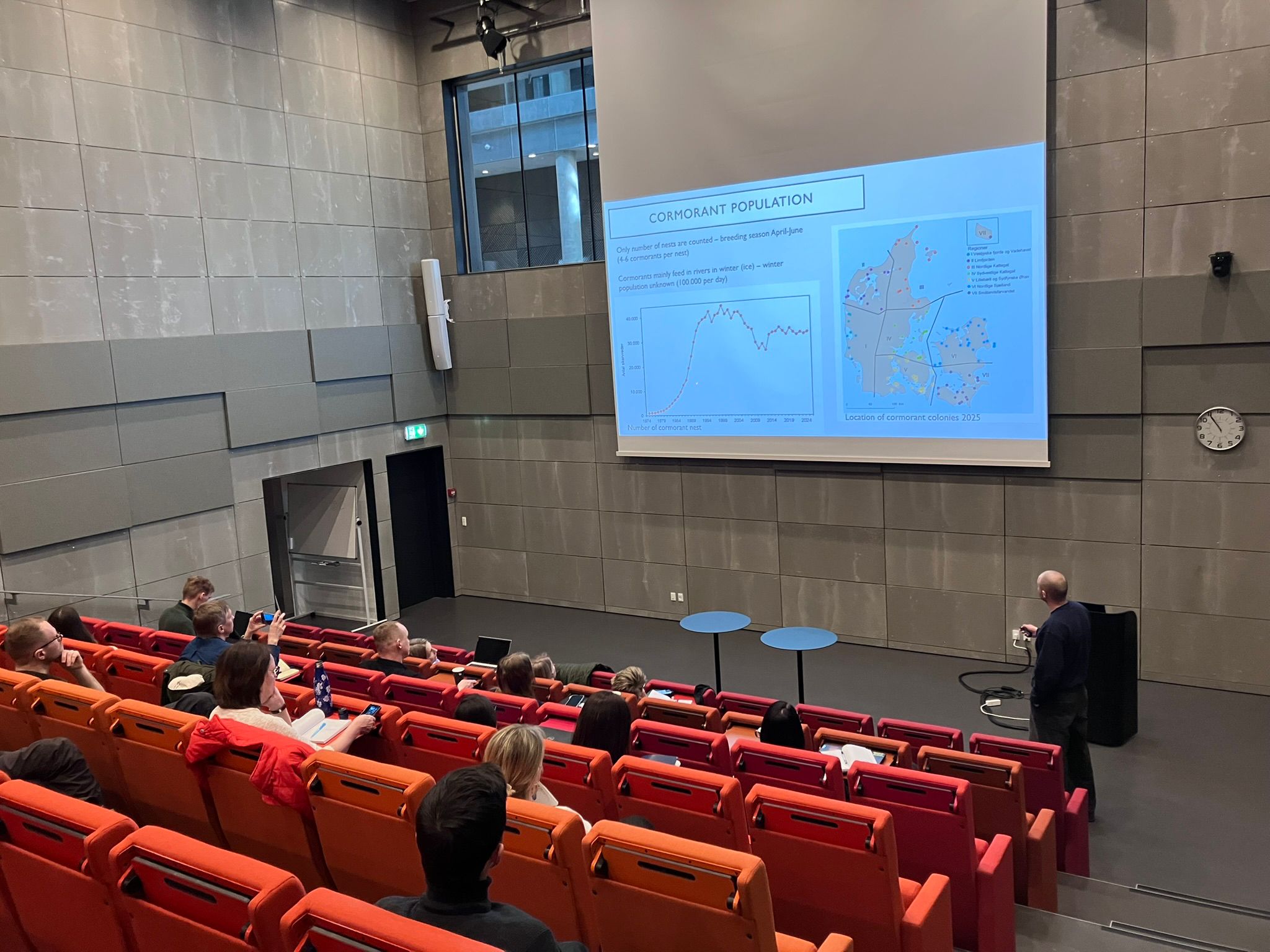
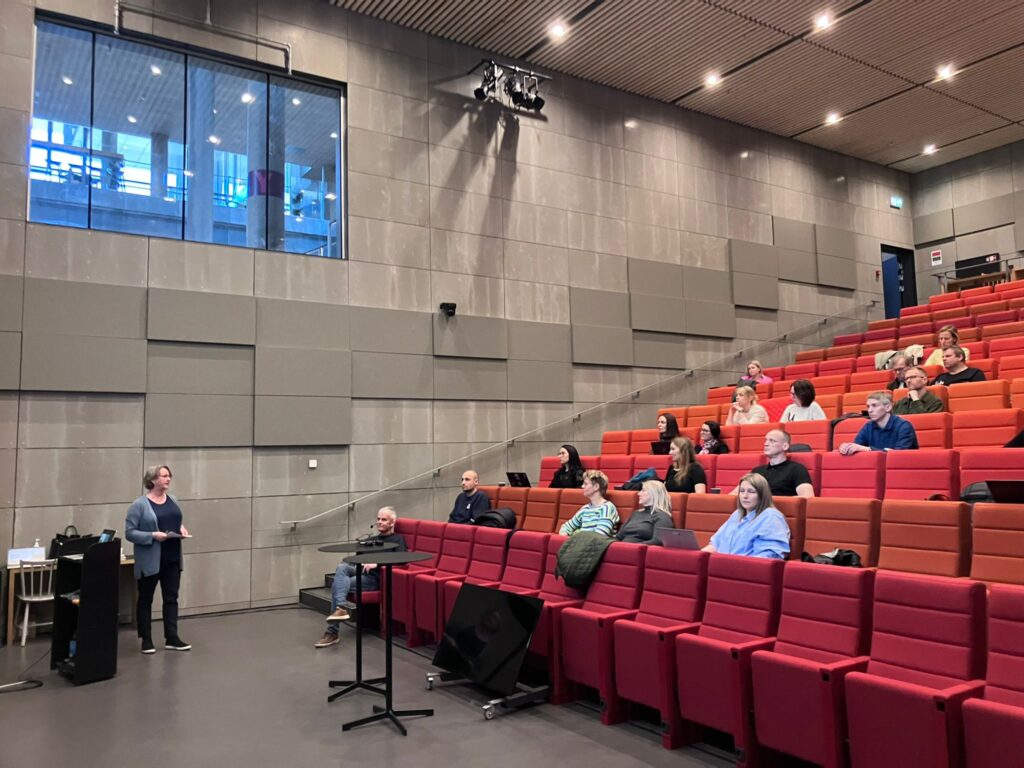
On 22 April 2026, representatives from the Estonian Ministry of Climate visited Aarhus (Denmark) for a knowledge exchange mission focused on river management, ecological status assessment and implementation of the EU Water Framework Directive (WFD). Organised together with the Municipality of Aarhus, the visit brought together public authorities and scientific experts. To discuss freshwater ecosystem management, fish conservation and emerging environmental challenges across the Baltic region.
As part of the programme, ProtectFish partner DTU Aqua was invited to present ongoing Danish research on cormorant predation in rivers and streams. This last is an issue gaining increasing attention in Estonia as cormorant numbers continue to rise.
Sharing danish experience on cormorant predation
Marine biologist Mathis Olesen, working at DTU Aqua, participated as one of two guest speakers during the visit. His presentation focused on decades of Danish research examining the impact of cormorants on river fish populations, including salmonids, grayling and brook trout.
Mathis Olesen’s presentation’s starting point was that after decades with increasing fish populations in rivers and streams, a new downward trend has been observed nationwide. On all measured parameters, the habitat quality has been increasing (less pollution, less barriers, more restoration, etc.) .
According to him, Denmark has accumulated extensive expertise on cormorant predation through telemetry studies, PIT-tag recoveries and exclusion experiments. These practical tests demonstrated significant predation pressure by cormorants in rivers and streams. According to the research presented during the meeting by Mathis, predation rates on migrating smolts in Danish rivers range between 22% and 88%, depending on the river system and study design.
The Estonian delegation also received an overview of the ongoing work carried out in Denmark under our Horizon Europe-funded ProtectFish project. Early project findings indicate promising results regarding targeted management of cormorant predation in Danish rivers.
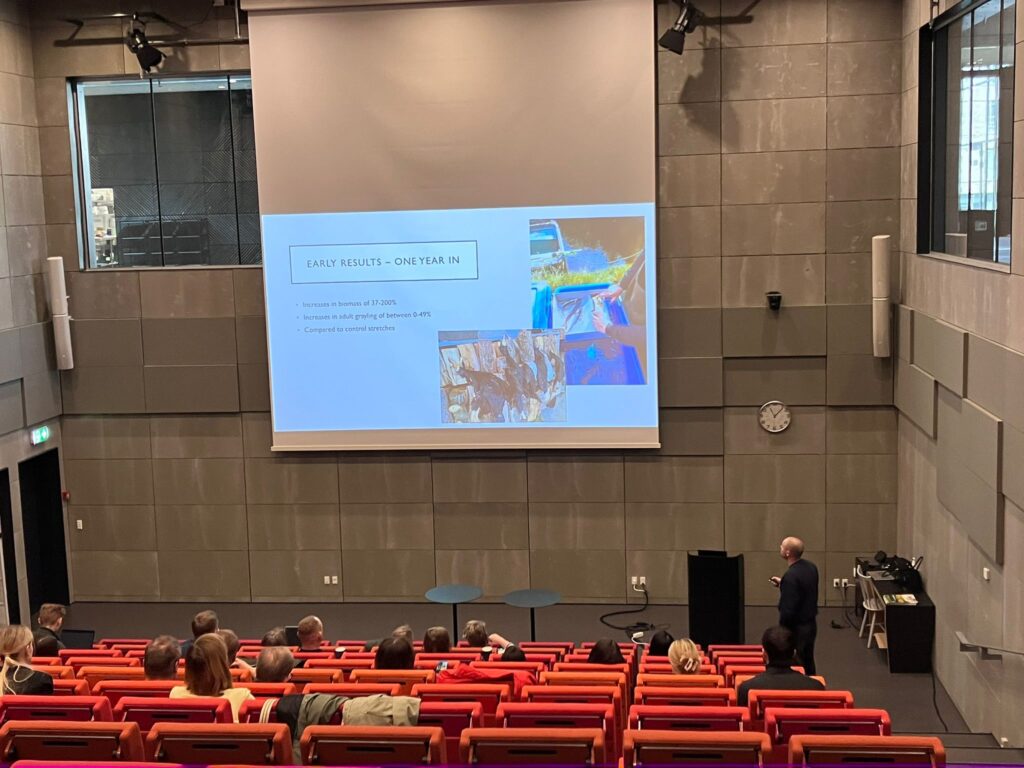
The research carried out on selected river stretches in Grindsted Å, Arnå and Storå (under ProtectFish) provided important insights into the potential benefits of targeted and adaptive management approaches for protecting vulnerable river fish populations. Compared to control stretches without management actions, researchers observed increases in overall fish biomass ranging from 37% to 200%, as well as increases in adult grayling populations of between 0% and 49%. More on this here
Estonia looking ahead
While Estonia still maintains relatively healthy fish stocks in many coastal and river systems, national authorities wish to prevent potential future pressures that could affect these ecosystems — including growing cormorant populations.
“Estonia still has relatively healthy fish populations along its coasts and in its rivers. They are very interested in keeping it that way and are looking into challenges that could change this in the future, including cormorants,” explained Olesen.
Among Baltic countries, Estonia is often considered being in a situation similar to where Denmark was approximately 15 years ago regarding predation-related challenges. The exchange therefore provided an important opportunity to discuss both scientific evidence and practical management experiences linked to balancing bird protection with freshwater fish conservation.
Links & further reading
ProtectFish fieldwork in Denmark – More fish in the rivers! – Protectfish