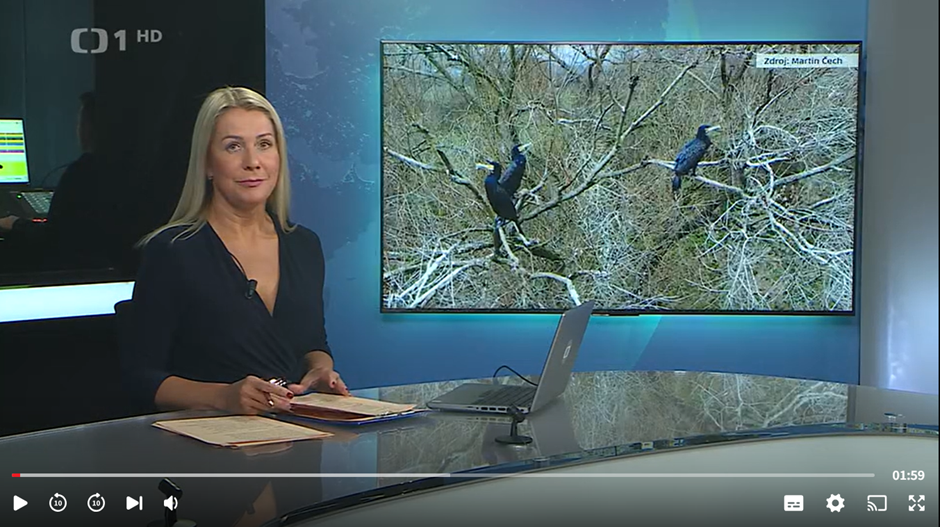
Early January 2026, the ProtectFish project gained wide national visibility in Czechia, with its field experiments on cormorant exclusion in several Czech rivers. This work was featured on Czech State Television (Česká televize), CNN Prima NEWS and on the Czech State Radio (Český rozhlas) in mid-January 2026 and included a nationwide edition with sign-language interpretation covering ProtectFish research activities – ensuring broad public accessibility. The media attention continued with a live interview with our project partner assoc. Prof. Dr. Martin Čech on Český rozhlas Plus, one of the country’s main public radio channels (LINK to audio).
Spotlight on ProtectFish fieldwork on the Střela River, Czechia
The interviews were recorded at the Střela River in West Bohemia, approximately 120 km west of Prague. This location is a key ProtectFish field site, where experimental work has been ongoing since autumn 2025.
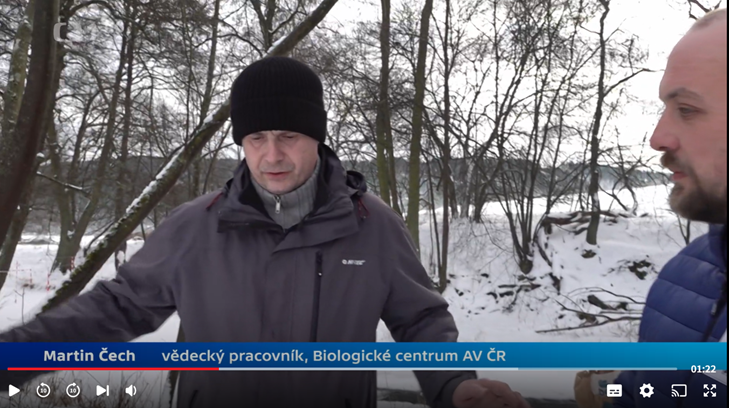
In January 2026, the river stretches were exceptionnaly affected by extreme winter conditions, with temperatures reaching –15 °C and extensive ice cover. “This is creating a good protection barrier for grayling against predation” – highlights our project partner Martin Čech. “The ProtectFish experiments nevertheless aim to assess long-term, scalable mitigation measures that remain effective beyond seasonal weather effects”.
Testing predation exclusion measures
The media reports focused on the ProtectFish’s investigating cormorant exclusion techniques using a before–after control–impact experimental design.
As a first step, ProtectFish researchers estimated the fish stocks (species, sizes, numbers/abundance) by conducting a series of electrofishing surveys on the Střela and Svatava rivers in late autumn 2025. Following this, visual exclusion barriers were installed, using UV-resistant white plastic ropes and red-and-white plastic belts to protect the selected river stretches from cormorant predation activities.
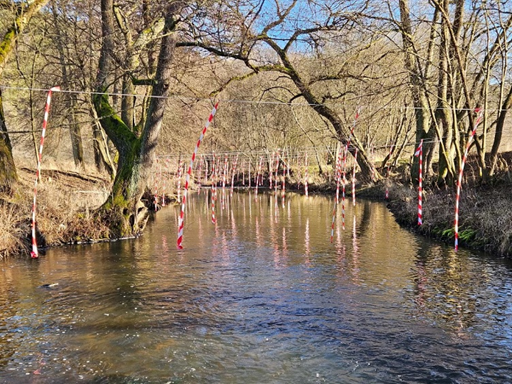
Photo: Martin Čech, BCCAS
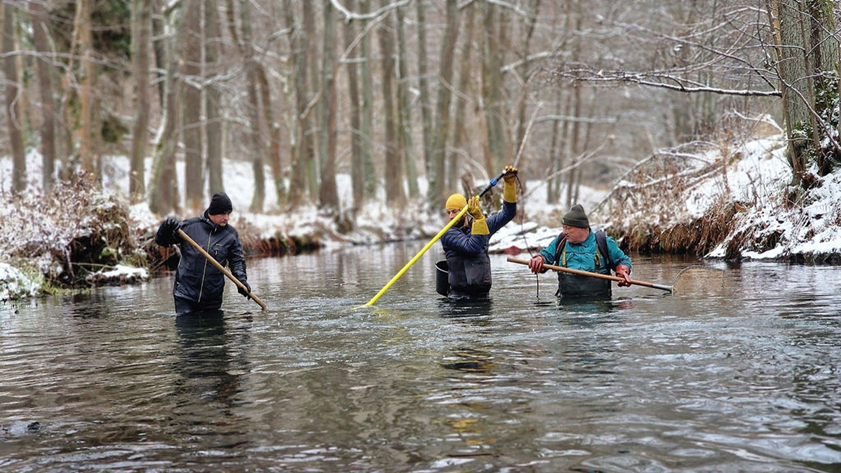
Photo: Martin Čech, BCCAS
At the start of spring 2026, when cormorants migrate away from Czechia, the barriers will be removed and electrofishing repeated. The results will allow researchers to compare fish stocks in:
- protected river stretches,
- unprotected control stretches, and
- sections with higher habitat complexity – to evaluate the impact of habitat on fish predation success.
Strong public & media response in Czechia
This ProtectFish partners’ communication activity has triggered a substantial public interest in Czechia. A related post published in December 2025 on the official Facebook page of the Biology Centre of the Czech Academy of Sciences (BCCAS) reached over 60,000 views, becoming one of the institute’s most widely viewed posts to date.
On 13 January 2026, BCCAS also released a press statement on their activities under ProtectFish, which was rapidly taken up by the Czech Academy of Sciences and subsequently disseminated in many national and regional media including the most read Czech newspaper Mladá fronta DNES, main internet newspapers like iDNES and Novinky.cz, nature conservation newspapers (e.g. Ekolist.cz) or anglers newspapers (e.g. Aktivni-rybolov.cz).
This broad media uptake shows the relevance of evidence-based research on cormorant–fish interactions beyond the scientific community.
Links towards live TV and radio broadcasting
Radio interview (in CZ): https://program.rozhlas.cz/zaznamy#/plus/39/2026-01-15
TV broadcasting: Vědci testují zábrany proti kormoránům – 13. ledna – Události v regionech (jih a západ) | Česká televize
Other public attention following live TV and radio broadcasting
Scientists are investigating the decline of fish, the main suspects are cormorants
Sources & further reading:
Jaký vliv mají kormoráni na úbytek ryb? Vědci zahajují terénní pokusy – Akademie věd České republiky