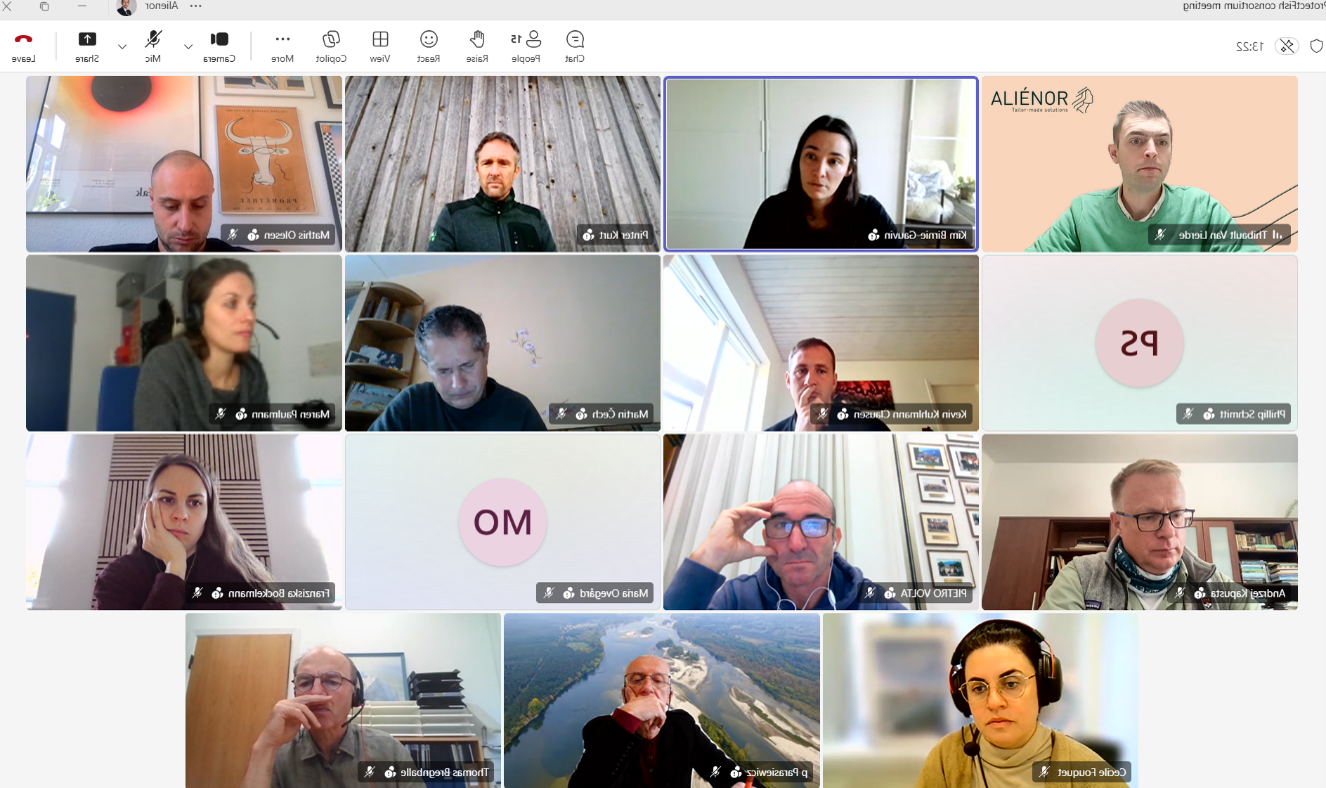
ProtectFish partners met on 19 October 2026 to share research updates and plan upcoming project activities. Discussions focused on preparations for European cormorant counts in 2027, progress with fish assessments and fieldwork, and policy questions emerging from the project.
Preparing European cormorant counts
During the meeting, partners discussed the ongoing preparations for the upcoming count of wintering cormorants in January 2027 and breeding colonies across Europe in spring 2027.
Aarhus University, which leads work package 2, has identified coordinators for almost all countries that will participate in the count. The university is also developing counting guidelines and an online tool through which scientists and members of the public can report their bird observations. Additional EU funding received by the university has helped meet the costs of organising these counts.
Alongside these preparations, partners continue to gather historical data on breeding populations and information on management measures. They are also examining which criteria should be considered when defining favourable conservation status for cormorants.
Sharing progress from fish assessments and fieldwork
The project partners Federal Institute of Hydrology – BfG, BOKU University and Danmarks Tekniske Universitet – DTU Aqua shared updates on their fieldwork activities investigating measures to protect fish from predation. Work to assess grayling populations is expanding from Germany to Sweden, Denmark and Austria – shared by the BfG. An initial assessment of barbel (by the BfG) is also under development.
In Germany, preliminary observations suggest that fish density increased more in stretches with cover (e.g. overnetting of the river stretches, more here) than in those without such materials, this at two of the three monitored sites. Early observations from DTU Aqua in Denmark suggest that grayling density may have increased – thanks to protective measures, as e.g. cormorant deterrence activities (scaring away) – although it is still too early to draw conclusions.
Further experiments on habitat complexity are planned in Denmark from late November 2026 and in Austria in spring 2027. Cormorant tracking work has also expanded, with more birds tagged and data added from birds in Finland, Hungary and other countries.
Discussing policy questions and next steps
Drawing on the project’s research, experiments in several countries and experiences shared by stakeholders, partners discussed how Member States interpret and apply derogations under the Birds Directive. Project partners considered whether ProtectFish could compare national experiences and suggest options to highlight recommendations & key messages via an e.g. upcoming project policy brief.
Another question discussed among the members was whether modelling could help estimate how much predation some particular fish populations can withstand. Partners also discussed effects beyond fish numbers, including possible changes in fish size structure, food webs and the surrounding environment.
The meeting also provided an opportunity to review communication activities, including the publication of the project’s first policy brief and its presentation at the EIFAAC workshop in Riga in September 2026. Partners also noted a growing newsletter engagement and increased visibility on LinkedIn.
Partners will meet in person for their annual meeting in Denmark in April 2027.