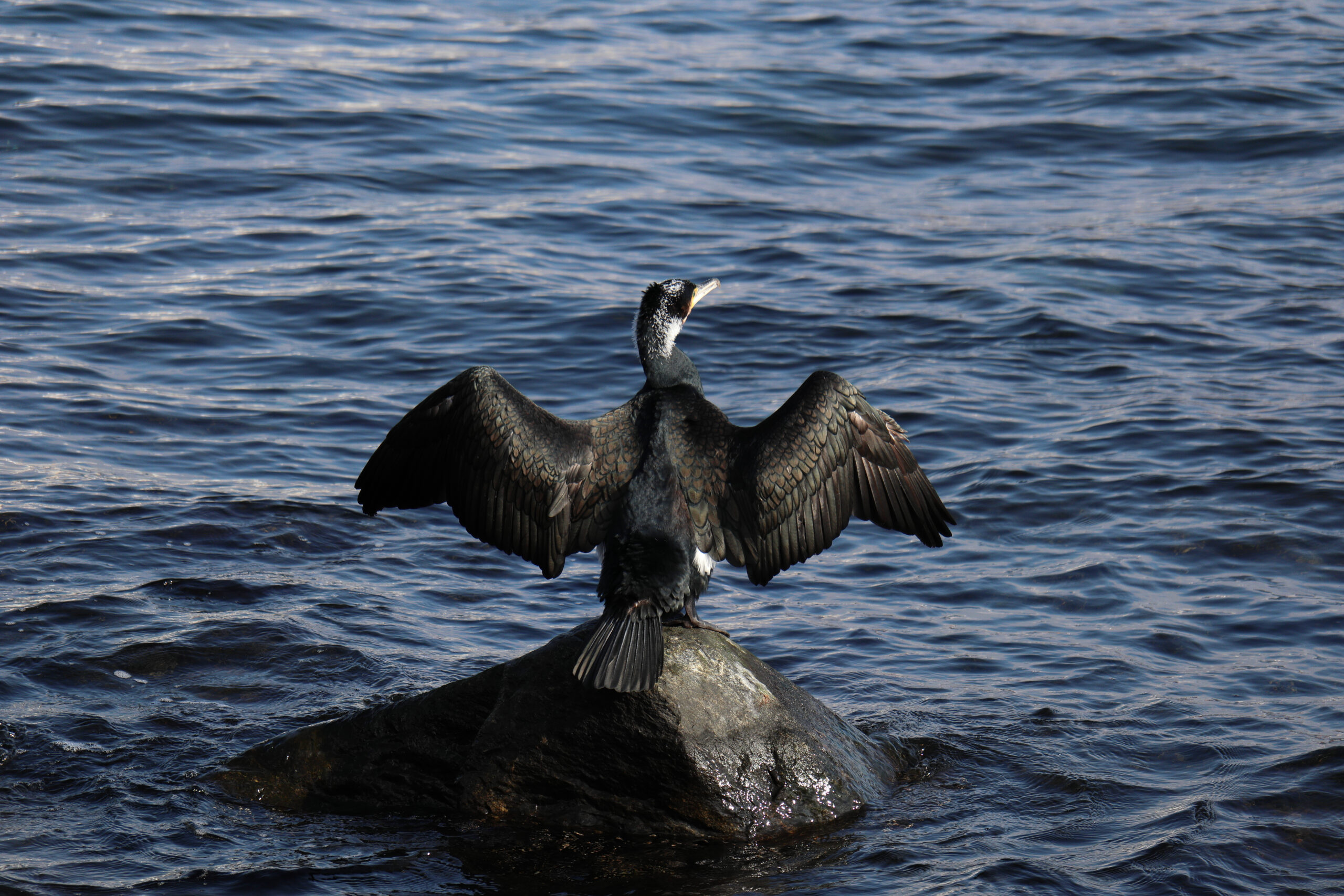
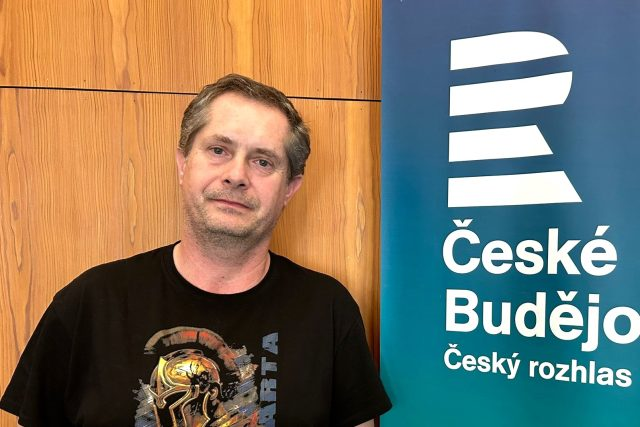
On 18 February 2026, hydrobiologist Martin Čech (Biology Centre of the Czech Academy of Sciences – BCCAS) presented the latest details on his work in the framework of the ProtectFish project in a 30-minute live interview on Czech national radio (broadcast Právě teď). The discussion focused on the impact of the great cormorant (Phalacrocorax carbo) on river ecosystems, threatened fish species, biodiversity and fisheries in the Czech Republic and across Europe. The interview highlighted the ongoing ProtectFish field experiments in Czechia, and the need for coordinated European-level solutions.
Great Cormorant predation pressure in European rivers
The great cormorant (Phalacrocorax carbo) is one of Europe’s most prominent fish-eating bird species. Its recent population growth and migratory patterns have contributed to ongoing discussions. This about its ecological and economic interactions within inland river ecosystems.
In the interview, Martin Čech outlines the particular conditions this winter: extended periods of frost have left many river sections frozen, concentrating fish in limited ice-free areas and thereby creating favourable feeding opportunities for large flocks of cormorants. In Pilsen, an estimated 2,000 cormorants have gathered near the Radbuza River. Obviously, an illustrative example of these winter dynamics, according to Martin Čech.
Preservation of fish biodiversity and fisheries
Concentrated winter predation adds an additional strain to the Czech river ecosystems. Which are already affected by habitat fragmentation, hydromorphological changes and climate pressures. Cormorant predation worsens their ecological and socio-economic challenges. In the Czech Republic, the annual losses are estimated in tens of millions of Czech crowns. Specifically, for commercial fisheries and at least in the same value for recreational fisheries. Subsequently, sustained predation pressure may also undermine conservation efforts targeting vulnerable native fish species.
ProtectFish experiments in the Karlovy Vary region (Czechia)
ProtectFish Czech scientists – including from BCCAS – are conducting targeted field experiments. This to better assess the role of great cormorants in fish population dynamics.
Selected sections of the Střela and Svatava rivers (Karlovy Vary region) are equipped with streamer systems, generating optical and acoustic stimuli & limit bird landing opportunities.
The aim is to produce evidence-based data on whether non-lethal deterrence can reduce predation pressure and support the recovery of protected native fish species.
Cormorant management: the need for European coordination
In his interview, Martin Čech underlines that legal local shootings of cormorants address the consequence rather than the root causes of the problem. Czech breeding populations remain limited (around 300–350 pairs in only 6-7 breeding colonies for last 25 years), while new birds come from northern and Baltic every winter. Summing up, tis dynamic highlights the importance of a coordinated European solution, including preventive measures in key breeding areas.
Science-based support for policy
By generating robust scientific evidence on predator–prey interactions, river ecosystem resilience and mitigation options, ProtectFish contributes to informed policy-making. Through research and stakeholder engagement, the project aims atreconcile bird and fish biodiversity conservation policies.
The full interview with Martin Čech is available via Czech National Radio (LINK).
A written interview – on the same topic – with journal Český rybář can be accessed via this link